Saturday, 11 December 2010
Friday, 10 December 2010
The Crit
Every term one of the most exciting and enjoying part is the crit. Unlike previous ones which we printed and stick on white walls, this year we use projector. The Rollei film projector is amazing with such a vivid cinematic quality, but as the film mount is only good for 6 X 6 or 6 X 4.5 and our trannie is 6 X 7, we have to use the digital projector to project the scanned images, which the quality can not compare with the film one.
Sunday, 5 December 2010
MAMIYA RB67 LENS
We used 90mm f3.5 lens for the project, but there are a wide variety of lenses available for the RZ67:
4 wide-angle lenses:
37 mm f/4.5 Fisheye, the widest RZ lens ever produced, 18 mm equivalent in 135-format
50 mm f/4.5 ULD L, 2 versions (the older one is inferior in terms of contrast and resolution, the ULD version has an additional floating system focus ring), 24 mm equivalent
65 mm f/4, two versions (the second one has a floating element), 32 mm equivalent
75 mm f/3.5, with floating element, 36 mm equivalent
3 normal lenses:
90 mm f/3.5, 44 mm equivalent
110 mm f/2.8, smallest of the RZ lenses, also has largest aperture, 53 mm equivalent
127 mm f/3.5 and an older model f/3.8, 62 mm equivalent
8 telephoto lenses:
150 mm f/3.5, 73 mm equivalent
180 mm f/4.5, 87 mm equivalent
210 mm f/4.5 APO, apochromatically corrected design, 102 mm equivalent
250 mm f/4.5, 2 versions (newer one is APO), 121 mm equivalent
350 mm f/5.6 APO, 170 mm equivalent
360 mm f/6.0, an older lens, 175 mm equivalent
500 mm f/6 APO and an older model f/8, longest of the RZ lenses, 238 mm equivalent
6 specialty lenses:
75 mm f/4.5 Short Barrel, possible to use with a tilt/shift adapter for perspective and focus plane control, needs an SB spacer for normal 75 mm use, 36 mm equivalent
75 mm f/4.5 Shift, perspective control lens, needs manual cocking of the shutter, 36 mm equivalent
140 mm f/4.5 Macro, two versions (the newer one with floating element system), able to shoot 1:3 without extension tubes or bellows and 1:1 with extension tubes 1 and 2, 68 mm equivalent
180 mm f/4 Variable Soft Focus, uses three interchangeable diffusion and spherical aberration disks for soft effect, 87 mm equivalent
180 mm f/4.5 Short Barrel, for tilt and shift adapter, needs an SB spacer for normal 180 mm use, 87 mm equivalent
100-200 mm f/5.2 Zoom, the only RZ zoom lens, 48-97 mm equivalent
Saturday, 4 December 2010
Getting ready for Print
Yesterday we looked at preparing some of the images for print.
We managed to print two that worked well. The third shoot image needs a little more work in photoshop or to use another transparency that is better lit.
The two we have printed successfully so far are:
We managed to print two that worked well. The third shoot image needs a little more work in photoshop or to use another transparency that is better lit.
The two we have printed successfully so far are:
Shoot 4 digital shots: getting the light right and composition
We discussed using a different person to be the priest but in the end we decided to keep it consistent.
This meant that I didn't get to press the shutter button but I did more that just act the priest for each of the images. Each image was a group creation, collectively making the image - crafting the light and composition was a joint affair. We problem solved together and managed to sort out a rogue light that was lighting up the background unknowingly and causing a strange light spill on the background. Someone had mistakenly plugged in an additional light that was hidden behind one of the soft boxes, messing up our lighting - until this was discovered. Robert
Polaroid from 4th and final shoot - hopefully!
![]() |
| f9.5 125 |
Final shoot: less flesh in the shots makes a difference, so we needed to ensure that any exposed flesh was well lit.
Composing the image to suggest a tension between the woman gazing at the priest whilst being held by the hand and in the loving? desiring? gaze of another woman.
Suggesting a conflict between the women and the priest, the church and beyond regarding their relationship? Sexuality?
There is an absence of rhetoric from the church about love between women, sex between women thus made invisible and therefore silenced. The image suggests all sorts of possible relationships between the characters. The priest is looking away which is significant - a way of ignoring, silencing the 'other' and not acknowledging their existence, visibility.
![]() |
| Red filter on the backlight. We used a honeycomb in front of the snooded light too to soften the light and light up the hands. |
.
Thursday, 2 December 2010
Polaroids from 3rd shot
![]() |
| f11 / 125 |
Does this image refer to the catholic church's colonial project? Its anti communist position and its colonial history in China? The church's relationship to the state and the impact it has had on silencing many. The Cathars for example, silenced through the crusade slaughters in France from the 1100s onwards. Radical theology attacked by the catholic church in Latin America. 100s of years of missions 'converting' the other in their native lands.
Digital images from the shoot:
We needed to ensure that the face of the kneeling actor was lit well enough.
Monday, 29 November 2010
GROUP PROJECT – THIRD FRAME MODELLING EXPERIENCE
Frame 3 – Work in Progress
We did the fourth shooting. This time we managed to finish the third frame. It was quite improvising. We brought quite a few props, and tried different set-ups out. Photography is a visual way to express. Sometimes you can visualise in mind but you better shoot and see the image to decide if you like or not. On top of this, you could try different setups by just combining different props when shooting, and sometimes there might be something different than you have expected. Anyway, we tried to create a signifier for colonisation. I became one of the models. Standing or kneeling for even just one hour will be quite tiresome. When I had to freeze myself for the final film shooting after digital trials, it was not easy after long time of modelling, I could feel myself move a little, which I knew it is so bad for shooting, as a tiny movement will cause some inaccuracy of composition. Constructive shooting needs everything to be precise as planned, prop position, model posture, lighting, exposure, focus, everything… It has to be a combination of perfection to achieve a good constructed photo. Anyway, it was quite tiresome maybe because my knee problem etc. As we run out of Polaroid we were not quite sure of the final result. Look forward to seeing the transparency to be developed next week.
Kun
Friday, 26 November 2010
Wednesday, 24 November 2010
Vatican & Homosexuality
Every human being is called to receive a gift of divine sonship, to become a child of God by grace. However, to receive this gift, we must reject sin, including homosexual behavior—that is, acts intended to arouse or stimulate a sexual response regarding a person of the same sex. The Catholic Church teaches that such acts are always violations of divine and natural law.
Homosexual desires, however, are not in themselves sinful. People are subject to a wide variety of sinful desires over which they have little direct control, but these do not become sinful until a person acts upon them, either by acting out the desire or by encouraging the desire and deliberately engaging in fantasies about acting it out. People tempted by homosexual desires, like people tempted by improper heterosexual desires, are not sinning until they act upon those desires in some manner.
Divine Law
The rejection of homosexual behavior that is found in the Old Testament is well known. In Genesis 19, two angels in disguise visit the city of Sodom and are offered hospitality and shelter by Lot. During the night, the men of Sodom demand that Lot hand over his guests for homosexual intercourse. Lot refuses, and the angels blind the men of Sodom. Lot and his household escape, and the town is destroyed by fire "because the outcry against its people has become great before the Lord" (Gen. 19:13).
Throughout history, Jewish and Christian scholars have recognized that one of the chief sins involved in God’s destruction of Sodom was its people’s homosexual behavior. But today, certain homosexual activists promote the idea that the sin of Sodom was merely a lack of hospitality. Although inhospitality is a sin, it is clearly the homosexual behavior of the Sodomites that is singled out for special criticism in the account of their city’s destruction. We must look to Scripture’s own interpretation of the sin of Sodom.
Jude 7 records that Sodom and Gomorrah "acted immorally and indulged in unnatural lust." Ezekiel says that Sodom committed "abominable things" (Ezek. 16:50), which could refer to homosexual and heterosexual acts of sin. Lot even offered his two virgin daughters in place of his guests, but the men of Sodom rejected the offer, preferring homosexual sex over heterosexual sex (Gen. 19:8–9). Ezekiel does allude to a lack of hospitality in saying that Sodom "did not aid the poor and needy" (Ezek. 16:49). So homosexual acts and a lack of hospitality both contributed to the destruction of Sodom, with the former being the far greater sin, the "abominable thing" that set off God’s wrath.
But the Sodom incident is not the only time the Old Testament deals with homosexuality. An explicit condemnation is found in the book of Leviticus: "You shall not lie with a male as with a woman; it is an abomination. . . . If a man lies with a male as with a woman, both of them have committed an abomination; they shall be put to death, their blood is upon them" (Lev. 18:22, 20:13).
Reinterpreting Scripture
To discount this, some homosexual activists have argued that moral imperatives from the Old Testament can be dismissed since there were certain ceremonial requirements at the time—such as not eating pork, or circumcising male babies—that are no longer binding.
While the Old Testament’s ceremonial requirements are no longer binding, its moral requirements are. God may issue different ceremonies for use in different times and cultures, but his moral requirements are eternal and are binding on all cultures.
Confirming this fact is the New Testament’s forceful rejection of homosexual behavior as well. In Romans 1, Paul attributes the homosexual desires of some to a refusal to acknowledge and worship God. He says, "For this reason God gave them up to dishonorable passions. Their women exchanged natural relations for unnatural, and the men likewise gave up natural relations with women and were consumed with passion for one another, men committing shameless acts with men and receiving in their own persons the due penalty for their error. And since they did not see fit to acknowledge God, God gave them up to a base mind and to improper conduct. . . . Though they know God’s decree that those who do such things deserve to die, they not only do them but approve those who practice them" (Rom. 1:26–28, 32).
Elsewhere Paul again warns that homosexual behavior is one of the sins that will deprive one of heaven: "Do you not know that the wicked will not inherit the kingdom of God? Do not be deceived: Neither the sexually immoral nor idolaters nor adulterers nor male prostitutes nor homosexual offenders nor thieves nor the greedy nor drunkards nor slanderers nor swindlers will inherit the kingdom of God" (1 Cor. 6:9–10, NIV).
All of Scripture teaches the unacceptability of homosexual behavior. But the rejection of this behavior is not an arbitrary prohibition. It, like other moral imperatives, is rooted in natural law—the design that God has built into human nature.
Natural Law
People have a basic, ethical intuition that certain behaviors are wrong because they are unnatural. We perceive intuitively that the natural sex partner of a human is another human, not an animal.
The same reasoning applies to the case of homosexual behavior. The natural sex partner for a man is a woman, and the natural sex partner for a woman is a man. Thus, people have the corresponding intuition concerning homosexuality that they do about bestiality—that it is wrong because it is unnatural.
Natural law reasoning is the basis for almost all standard moral intuitions. For example, it is the dignity and value that each human being naturally possesses that makes the needless destruction of human life or infliction of physical and emotional pain immoral. This gives rise to a host of specific moral principles, such as the unacceptability of murder, kidnapping, mutilation, physical and emotional abuse, and so forth.
"I Was Born This Way"
Many homosexuals argue that they have not chosen their condition, but that they were born that way, making homosexual behavior natural for them.
But because something was not chosen does not mean it was inborn. Some desires are acquired or strengthened by habituation and conditioning instead of by conscious choice. For example, no one chooses to be an alcoholic, but one can become habituated to alcohol. Just as one can acquire alcoholic desires (by repeatedly becoming intoxicated) without consciously choosing them, so one may acquire homosexual desires (by engaging in homosexual fantasies or behavior) without consciously choosing them.
Since sexual desire is subject to a high degree of cognitive conditioning in humans (there is no biological reason why we find certain scents, forms of dress, or forms of underwear sexually stimulating), it would be most unusual if homosexual desires were not subject to a similar degree of cognitive conditioning.
Even if there is a genetic predisposition toward homosexuality (and studies on this point are inconclusive), the behavior remains unnatural because homosexuality is still not part of the natural design of humanity. It does not make homosexual behavior acceptable; other behaviors are not rendered acceptable simply because there may be a genetic predisposition toward them.
For example, scientific studies suggest some people are born with a hereditary disposition to alcoholism, but no one would argue someone ought to fulfill these inborn urges by becoming an alcoholic. Alcoholism is not an acceptable "lifestyle" any more than homosexuality is.
The Ten Percent Argument
Homosexual activists often justify homosexuality by claiming that ten percent of the population is homosexual, meaning that it is a common and thus acceptable behavior.
But not all common behaviors are acceptable, and even if ten percent of the population were born homosexual, this would prove nothing. One hundred percent of the population is born with original sin and the desires flowing from it. If those desires manifest themselves in a homosexual fashion in ten percent of the population, all that does is give us information about the demographics of original sin.
But the fact is that the ten percent figure is false. It stems from the 1948 report by Alfred Kinsey, Sexual Behavior in the Human Male. The study was profoundly flawed, as later psychologists studying sexual behavior have agreed. Kinsey’s subjects were drawn heavily from convicted criminals; 1,400 of his 5,300 final subjects (twenty-six percent) were convicted sex offenders—a group that by definition is not representative of normal sexual practices.
Furthermore, the ten percent figure includes people who are not exclusively homosexual but who only engaged in some homosexual behavior for a period of time and then stopped—people who had gone through a fully or partially homosexual "phase" but who were not long-term homosexuals. (For a critique of Kinsey’s research methods, see Kinsey, Sex, and Fraud, by Dr. Judith Reisman and Edward Eichel [Lafayette, Louisiana: Lochinvar & Huntington House, 1990].)
Recent and more scientifically accurate studies have shown that only around one to two percent of the population is homosexual.
"You’re Just a Homophobe"
Those opposed to homosexual behavior are often charged with "homophobia"—that they hold the position they do because they are "afraid" of homosexuals. Sometimes the charge is even made that these same people are perhaps homosexuals themselves and are overcompensating to hide this fact, even from themselves, by condemning other homosexuals.
Both of these arguments attempt to stop rational discussion of an issue by shifting the focus to one of the participants. In doing so, they dismiss another person’s arguments based on some real or supposed attribute of the person. In this case, the supposed attribute is a fear of homosexuals.
Like similar attempts to avoid rational discussion of an issue, the homophobia argument completely misses the point. Even if a person were afraid of homosexuals, that would not diminish his arguments against their behavior. The fact that a person is afraid of handguns would not nullify arguments against handguns, nor would the fact that a person might be afraid of handgun control diminish arguments against handgun control.
Furthermore, the homophobia charge rings false. The vast majority of those who oppose homosexual behavior are in no way "afraid" of homosexuals. A disagreement is not the same as a fear. One can disagree with something without fearing it, and the attempt to shut down rational discussion by crying "homophobe!" falls flat. It is an attempt to divert attention from the arguments against one’s position by focusing attention on the one who made the arguments, while trying to claim the moral high ground against him.
The Call to Chastity
The modern arguments in favor of homosexuality have thus been insufficient to overcome the evidence that homosexual behavior is against divine and natural law, as the Bible and the Church, as well as the wider circle of Jewish and Christian (not to mention Muslim) writers, have always held.
The Catholic Church thus teaches: "Basing itself on sacred Scripture, which presents homosexual acts as acts of grave depravity, tradition has always declared that homosexual acts are intrinsically disordered. They are contrary to the natural law. They close the sexual act to the gift of life. They do not proceed from a genuine affective and sexual complementarity. Under no circumstances can they be approved" (Catechism of the Catholic Church 2357).
However, the Church also acknowledges that "[homosexuality’s] psychological genesis remains largely unexplained. . . . The number of men and women who have deep-seated homosexual tendencies is not negligible. This inclination, which is objectively disordered, constitutes for most of them a trial. They must be accepted with respect, compassion, and sensitivity. Every sign of unjust discrimination in their regard should be avoided. These persons are called to fulfill God’s will in their lives and, if they are Christians, to unite to the sacrifice of the Lord’s cross the difficulties that they may encounter from their condition.
"Homosexual persons are called to chastity. By the virtues of self-mastery that teach them inner freedom, at times by the support of disinterested friendship, by prayer and sacramental grace, they can and should gradually and resolutely approach Christian perfection" (CCC 2357– 2359).
Paul comfortingly reminds us, "No temptation has overtaken you that is not common to man. God is faithful, and he will not let you be tempted beyond your strength, but with the temptation will also provide the way of escape, that you may be able to endure it" (1 Cor. 10:13).
Homosexuals who want to live chastely can contact Courage, a national, Church-approved support group for help in deliverance from the homosexual lifestyle.
Courage,
Church of St. John the Baptist
210 W. 31st St., New York, NY 10001
www.catholic.com
Pav
Tuesday, 23 November 2010
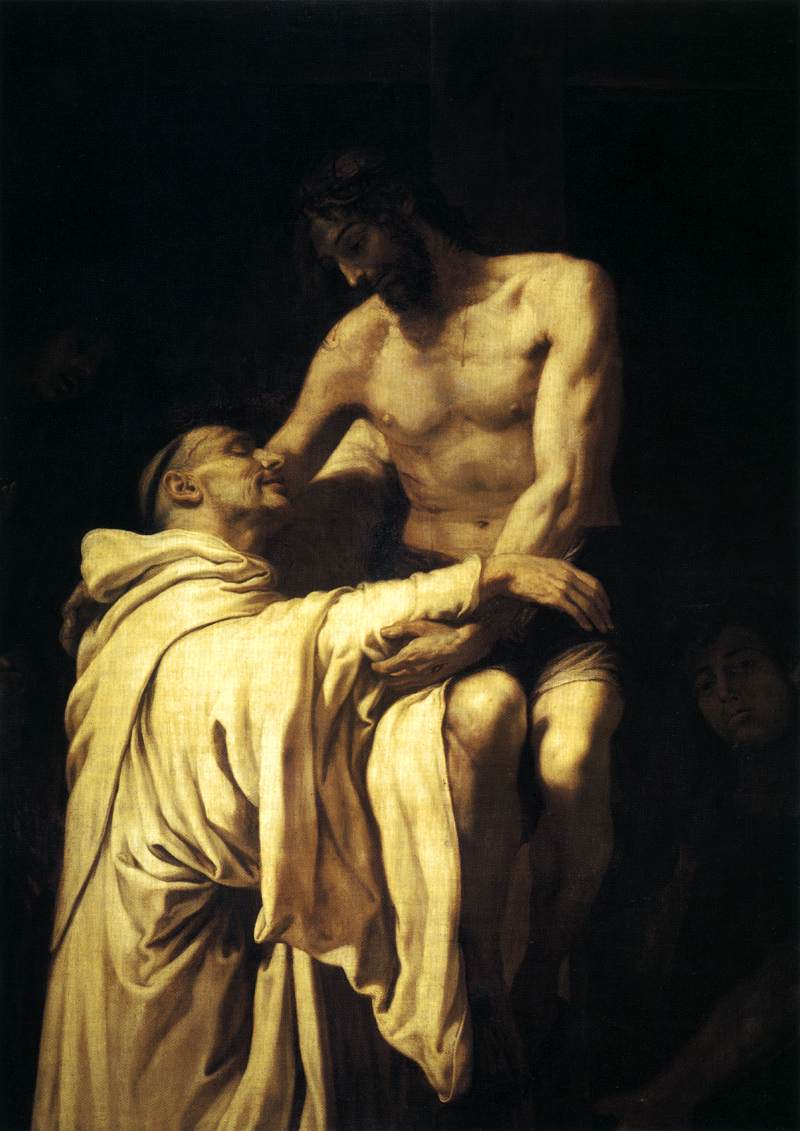
Francisco Ribalta - Christ Embracing Saint Bernard 1621-1625
Saint Bernard lived lived in the 12th century and is revered both for his contemplative writings and for founding Cistercian order. Ribalta portrays the saint without his bishop's mitre, a traditional ommission. Bernard's eyes are shut, emphasising his spiritual contemplation of Christ, rather than a literal, physical encounter. Ribalta's intention is to encourage us to emulate the saint and contemplate Christ's love of his Church.
2 things strike be about this painting. The first being the intimate 'composition' of Christ and Saint Bernard. The second being the shut eyes "emphasisng his spiritual contemplation". I wonder if this sense can be incorporated into photo 4.
Rob
2 things strike be about this painting. The first being the intimate 'composition' of Christ and Saint Bernard. The second being the shut eyes "emphasisng his spiritual contemplation". I wonder if this sense can be incorporated into photo 4.
Rob
Monday, 22 November 2010
Bill Viola
The Passions
Viola reworks the story of Christ’s death and resurrection in a modern medium, but influenced by classical heritage. He experiments with Renaissance symbolism, influenced by early Renaissance compositions and poses. The original paintings may be less visceral but are much more mesmerising.
Emergence
" In Emergence, Viola stages a scene with elements of entombment and resurrection in which two women sit by a well—water pouring from it—as a pale young man slowly rises to the surface. As the video progresses, they lift him from the water and lay him to rest on the ground. The piece is based on a fresco painting of the Pietà by the15th-century Italian artist Masolino, which depicts Christ in a sarcophagus, being supported on either side by his mourning mother and St. John. Viola used 35mm film to record the scene at 210 frames per second (almost seven times normal speed) before transferring it to high-definition video and extensively slowing the film—resulting in an image of dazzling clarity that reinforces the poignancy of the act, which is charged by associations of death and birth, grief and joy. "
http://getty.museum/news/press/center/viola_release_110807.html
http://www.youtube.com/watch?v=hx5Cu7U-Fkg&playnext=1&list=PL96DDB2E91A77E57C&index=2
Rob
Viola reworks the story of Christ’s death and resurrection in a modern medium, but influenced by classical heritage. He experiments with Renaissance symbolism, influenced by early Renaissance compositions and poses. The original paintings may be less visceral but are much more mesmerising.
Emergence
" In Emergence, Viola stages a scene with elements of entombment and resurrection in which two women sit by a well—water pouring from it—as a pale young man slowly rises to the surface. As the video progresses, they lift him from the water and lay him to rest on the ground. The piece is based on a fresco painting of the Pietà by the15th-century Italian artist Masolino, which depicts Christ in a sarcophagus, being supported on either side by his mourning mother and St. John. Viola used 35mm film to record the scene at 210 frames per second (almost seven times normal speed) before transferring it to high-definition video and extensively slowing the film—resulting in an image of dazzling clarity that reinforces the poignancy of the act, which is charged by associations of death and birth, grief and joy. "
http://getty.museum/news/press/center/viola_release_110807.html
http://www.youtube.com/watch?v=hx5Cu7U-Fkg&playnext=1&list=PL96DDB2E91A77E57C&index=2
Rob
Defrocking and Laicization
A priest in the Catholic church can be both Defrocked and Laicized. A priest may abandon or be removed from his ministry without being laicized, that is, without ceasing to be considered a priest in the eyes of the Church.
Defrocking
de·frocked, de·frock·ing, de·frocks
Defrocking
de·frocked, de·frock·ing, de·frocks
1. To strip of priestly privileges and functions.
2. To deprive of the right to practice a profession.
3. To deprive of an honorary position.
____________________________
Laicization
"A priest is automatically laicized when he marries or joins the military without permission. A priest may be voluntarily laicized by his superiors at his request. A priest may be involuntarily laicized for wrongdoing. Minor clerics, including priests, are laicized through the "penalty of degradation". Major clerics can be laicized by the Holy See.
Laicized priests are forbidden to wear clerical habit, identify themselves as priests, or administer the sacraments. The only exception would be to hear a confession in an emergency situation. They are required to continue practicing celibacy, although dispensations can be made. By laicization a priest loses the right of benefice, which in modern times means he will not be supported by the Church even after retirement."
http://www.newadvent.org/cathen/08744a.htm
When researching these terms, it is becoming increasingly difficult to find examples that are not linked to child sex abuse claims within the Church.
Rob
Laicization
"A priest is automatically laicized when he marries or joins the military without permission. A priest may be voluntarily laicized by his superiors at his request. A priest may be involuntarily laicized for wrongdoing. Minor clerics, including priests, are laicized through the "penalty of degradation". Major clerics can be laicized by the Holy See.
Laicized priests are forbidden to wear clerical habit, identify themselves as priests, or administer the sacraments. The only exception would be to hear a confession in an emergency situation. They are required to continue practicing celibacy, although dispensations can be made. By laicization a priest loses the right of benefice, which in modern times means he will not be supported by the Church even after retirement."
http://www.newadvent.org/cathen/08744a.htm
When researching these terms, it is becoming increasingly difficult to find examples that are not linked to child sex abuse claims within the Church.
Rob
A VISUAL REFERENCE FROM PARISPHOTO 2010
I could not find the name of the photographer and forgot to ask though...Was overwhelmed by loads of images on that day!
Kun
First Image Last Shot - Shooting Experience
I became the cameraman for the first shot. After a few tests on digital, based on the lighting set up in the second shooting, I used Mamiya RB67 for Polaroid test with 80mm lens and then started shooting on Fuji 100 transparency. I shot the 10 frame in one go bracketing. I was quite nervous even though I am familiar with the set up and the sitters. It was quite pressurising. I understood the sitter was standing there for a long time and I really wanted just to finish shooting and achieve the assignment. At the same time, I worried about the quality of the shot and was afraid to re-shoot in case of any imperfection. Anyway, in hindsight…
The focus is not easy especially when modelling light is not bright enough, so I should have increase the modelling light intensity and focus in a proper environment, though the focus was accurate.
I was bit clumsy, as I was not familiar with RB67. I used smaller Bronica and Mamiya before but RB67 is the first time, so I should have played with the kit to get familiar before shooting.
The scene in the viewfinder is smaller than the actual shot. I noticed it in the Polaroid print but I was not sure and hoping it was not the same for film. So I should have known the camera better.
I wanted change the set up by asking the sitters to step back a bit, but I just didn’t. I was worrying making too much hassle for them.
Anyway, the developed transparency looked nice but due to the viewfinder problem the black background rim showed at left and right edges of the each frame. There was one perfect though. We will use this one for scanning, printing and submission.
Kun
Friday 19th Polaroids
Sunday, 21 November 2010
Just interesting
The presumed subject of the painting Gabrielle d'Estrées et une de ses soeurs by an unknown artist (c.1594), is Gabrielle d'Estrées, mistress of King Henry IV of France. In the painting, Gabrielle sits up nude in a bath, holding (assumedly) Henry's coronation ring, whilst her sister sits nude beside her and pinches her right nipple. Henry gave Gabrielle the ring as a token of his love shortly before she died.
Her maternity is expressed in three ways: her sister pinches the source of the new mother's milk, the servant in the background knits in preparation for the child, and the fire in the fireplace signifies the mother's furnace. The love between Gabrielle and Henry IV is expressed by the painting of a love scene on the back wall and by the coronation ring.
This painting is interesting in that everything is peculiarly left-handedly-biased. Gabrielle's sister is pinching her right nipple with her left hand, d'Estrées is holding what is said to be King Henry IV of France’s coronation ring with her left hand, and the seamstress in the background is sewing with her left hand. Additionally, the painting hanging in the background is of the lower body of a naked person, but contrary to rumor, he is not holding his penis with his left hand. A piece of red fabric is draped over his genitals.
Melanie Manchot, The Fontainebleau Series, 2001
Pav
Subscribe to:
Posts (Atom)